By John A. Lupton, Illinois Supreme Court Historic Preservation Commission
Legal iconography has distinctive and consistent symbolism. For example, swords represent the power of the judiciary, while scales represent the fair weighing of evidence. Such symbols appear in the artwork concerning the legal system and in courthouses throughout the country. The Illinois law license is also rich in symbolism, but rather than featuring legal iconography, its imagery focuses on the state’s history.

Originally, Illinois law licenses had no symbolism because they were handwritten documents, signed by two or more justices of the Supreme Court. By the 1850s, however, the Court began using pre-printed licenses. One version had a lithograph of two women holding a shield featuring the seal of the State of Illinois with an eagle resting on top of the shield. A second version had the state seal and a few agrarian and transportation symbols, like a rake, train, and wheat shocks.
By the 1870s, Illinois adopted a new law license that heavily featured agriculture and transportation imagery. This license remains in use today. The prominent image at the top of the license is a modified version of the seal of the State of Illinois. It consists of an eagle, representing the United States, grasping a shield with its talons. The shield contains thirteen stars and thirteen stripes to honor the original thirteen states. Beneath the eagle are arrows and olive branches, which represent war and peace—powers reserved to the federal government.
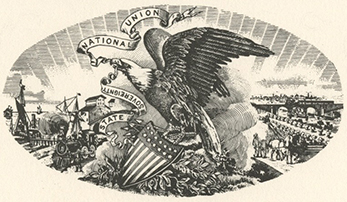
Held in the eagle’s beak is a banner with the state motto: State Sovereignty, National Union. In 1867, Illinois Secretary of State Sharon Tyndale advocated for a redesign of the state seal and fashioned a new seal that reversed the state motto to National Union, State Sovereignty to reflect the federal authority after the Civil War. The General Assembly rejected the change. Instead, Tyndale inverted “Sovereignty” and placed “National Union” above “State Sovereignty” to keep the motto intact but to de-emphasize the state in favor of the union.
The two images on the right and left of the eagle illustrate Illinois’s agricultural production and transportation networks. On the left, a locomotive hauls grain from Illinois farms to towering granaries, while large sailing ships traverse Lake Michigan carrying grain to eastern markets. One ship is loading its cargo directly from the granaries. The scene on the right shows a farmer riding on a grain wagon with rows of wheat shocks lining the Mississippi River. A steamboat passes under a bridge, while a locomotive crosses above it, representing the harmony between rail and river interests, working together instead of competing for transportation supremacy. A small town appears in the background, representing every town in the country that receives food products from Illinois, transported everywhere by river and rail. At the bottom center of the license, several agrarian symbols are grouped together: a shovel, plow, cart, and shock of wheat.
The identity of the artist who designed the law license remains unknown, but whoever it was understood the tensions between state and federal power and rail and river transportation networks. The current law license offers a powerful visual lesson in Illinois history.