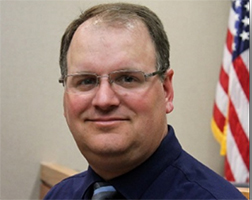
The Illinois Supreme Court is recognizing the work of trial court administrators across the state. The following features Twenty-Second Judicial Circuit Court Trial Court Administrator Dan Wallis and his thoughts on his career.
Tell us about your background and how it led to your role as a trial court administrator.
My journey was an interesting one that began in Ohio. I started my professional career working in law enforcement, corrections, and then as a probation officer. I worked as a probation officer for a couple of years, became the coordinator for our Drug Court program, and was then promoted to be the Director of Court Services. Six months later the Administrative Judge asked if I wanted to be the Court Administrator. I jumped at the opportunity, without even knowing what a court administrator did, or was. The court system that I was working in never had a court administrator and the position was still relatively new in the state. Thankfully, I partnered almost immediately with the Ohio Judicial College and the National Center for State Courts and became involved with the Institute for Court Management’s Certified Court Manager program. What was also interesting was that while I was the Court Administrator, I was also the Chief Adult and Juvenile Probation Officer. A rather unique combination.
What inspired you to pursue a career in the judicial branch?
I have spent most of my career in public service. I have worked in EMS, the fire service, law enforcement, and now the courts. Looking back, I think the common thread has always been pretty simple: I like helping people, and I like being in a position where I can make things better. What drew me to the judicial branch was the opportunity to do that in a different way. In EMS, fire, and law enforcement, you are often helping someone during an immediate crisis. In the courts, you still see people at some of the most difficult points in their lives, but you also have the opportunity to improve the system they are trying to navigate.
That is the part of court administration that I really enjoy. I like looking at how we do things and asking whether there is a better way. Can we make a process easier? Can we remove an unnecessary step? Can we give judges and employees tools? Can we make the courthouse a little less confusing or intimidating for the person who has never been there before? I want us to be the very best. At what? Simple – everything. For me, it really comes down to trying to leave things a little better than I found them.
How would you describe a typical day as a trial court administrator? What are your responsibilities?
What is a typical day? I am not sure there really is a typical day, and that is probably one of the things I enjoy most about the job. I may come into the office with a list of things I intend to accomplish, and within the first half hour that list can become completely irrelevant. Something happens in a courtroom, a judge needs assistance, we have a staffing issue, a facility problem comes up, there is a security concern, or somebody walks into my office with something that needs to be dealt with right now. You learn pretty quickly that flexibility is part of the job.
As trial court administrator, my responsibility is really to make sure the court has what it needs to function effectively every day. That covers a lot of territory. I work closely with the Chief Judge and the other judges on court operations, employment, budgeting, facilities, technology, security, personnel issues, and long-term planning. I also oversee a number of court programs and administrative functions and work regularly with the Circuit Clerk, State’s Attorney, Public Defender, Sheriff, Probation, County Administration, and many other justice and community partners.
There is also a lot of problem-solving involved. Sometimes those are big issues like space needs, budgets, new programs, technology, or changes in the law. Other times they are relatively small problems that still matter a great deal to the person experiencing them. Part of my job is figuring out which problems I can solve, which ones need somebody else at the table, and which ones require us to rethink the way we have always done something. It can be challenging.
I also spend a significant amount of time working with people. We have talented employees doing difficult work, and I think an important part of my responsibility is making sure they have the resources, support, and direction they need to be successful. I support them in every way that I can. I even offer to come out and help at the front counter when we are short-staffed. That really makes people nervous. Sometimes I think that the front office employees and the deputy court administrator would rather that I stay back in my office.
And then there is the public. It is easy in court administration to get caught up in budgets, statistics, policies, and procedures, but ultimately there is a person on the other end of almost everything we do. Most people do not come to the courthouse because everything in their life is going particularly well. They may be scared, frustrated, angry, confused, or simply unfamiliar with the process. I think we have an obligation to remember that. So, when I look at my responsibilities, I really see my role as keeping all those pieces moving in the same direction. Some days that means working on a major initiative that may take years to accomplish. Other days it means fixing a problem nobody knew existed when I walked through the door that morning.
What is the most challenging aspect of your job? What is the most rewarding?
I think the most challenging part of the job is that there is rarely a simple answer. Courts are complicated, loosely coupled organizations. You have judges, employees, elected officials, justice partners, attorneys, County Administration, and the public, and they do not always see an issue from the same perspective. Sometimes they have completely different priorities. My job is often to bring those different perspectives together, find some common ground, and figure out how we move forward. There is also a constant balance between what we would like to do and what we realistically can do. We have limited funding, limited space, limited staffing, and sometimes rules or procedures that simply do not move as quickly as we would like. That can be frustrating, particularly when you can see a better way of doing something but know that getting there is going to take time.
One of the things I have learned over the years is that change in the courts requires patience. You cannot always walk into a room, identify a problem, and fix it the next day. Sometimes you have to build relationships, develop trust, gather data, get the right people involved, and keep working at it. There are things we have accomplished that took years to get across the finish line.
The most rewarding part is seeing those efforts make a difference. Sometimes that means seeing a program we developed help somebody turn their life around. Sometimes it is watching an employee grow into a role and become successful. It may be seeing a new process save people time, watching technology eliminate something that frustrated everyone for years, or hearing from someone who came through the courthouse and felt like they were treated with dignity and respect. For me, the most rewarding part still comes back to people. Court administration can easily become about budgets, caseloads, statistics, policies, and performance measures. Those things are important, but they are not why we are here. Behind every case number is a person, and behind every successful court are people who come to work every day trying to do the right thing.
Who do you rely on, whether it be at the office or at home, when there’s a hectic day at work?
That’s an easy question. At work, Jill Dhamer, my Deputy Court Administrator, and at home, my wife, Laura.
Jill and I have worked together long enough that there is a great deal of trust between us. She understands how I think, she understands the court, and she knows when to challenge me. I do not need somebody who is simply going to agree with everything I say. I need somebody who will tell me when she thinks I am wrong, point out something I may have missed, and offer a different way of looking at a problem. Jill does that.
She also carries an enormous amount of responsibility herself, and I know that when I leave something is in her hands, it is going to get done. Having someone like that beside you makes you better at your own job.
At home, it is Laura.
One of the realities of this kind of work is that it can follow you home if you let it. There is always another issue to think about, another email that could be answered, or something coming tomorrow that is already occupying space in your head. Laura gives me perspective outside of all of that. She is supportive of what I do, but she also reminds me that there is a much bigger world outside the courthouse. She keeps me grounded, makes me laugh, and provides the balance that I wouldn’t create for myself. We like to go on adventures with each other, even if that means just floating on the lake. That isn’t something that I take for granted.
And then there is Honey, the Twenty-Second Judicial Circuit’s courthouse therapy dog, a female golden retriever, who happens to live with Laura and me. Honey has become a very important part of both worlds. At the courthouse, she has this incredible ability to calm people down without saying a word. She can walk into a room where someone is anxious, upset, or having a difficult day, and somehow the atmosphere changes. At home, she is just Honey. She is happy to see us, does not care how difficult the day was, and has a pretty simple way of reminding you that sometimes the best thing you can do is stop thinking about work and take her for an ATV ride, or take her to the lake where she has her very own float. She also sleeps with a cooling comforter and her very own memory foam pillow…no, the dog isn’t spoiled, just well cared for.
Is there anything else that you’d like to share?
Outside of work, scuba diving has become a real passion of mine, and I am working presently on my Divemaster certification and perhaps an instructor’s certification at some point. There is something about being underwater that completely changes your perspective. You are in an environment where everything slows down, you have to be focused on what you are doing, and for a little while, the rest of the world just disappears.
I have been fortunate enough to have some incredible experiences diving. One of the most memorable was diving with hammerhead sharks in Bimini. Seeing them in their own environment is something that is difficult to describe. They are powerful, graceful, and absolutely fascinating. It is one of those experiences that makes you realize very quickly that you are a visitor to their world, especially when a 14-foot hammerhead named Queen swims within 12 inches of you.
I have also spent time diving in the Florida Keys, which I really enjoy. The Keys offer a completely different experience with reefs, marine life, warm water, and just an incredible variety of things to see. Every dive is a little different, and that is part of what keeps me interested.
Most recently, Laura and I took our eldest granddaughter to the Georgia Aquarium, where I had the opportunity to dive with enormous manta rays and a 29-foot whale shark. Being in the water next to a whale shark is something I will never forget. You can know intellectually how large they are, but until one swims past you, it is hard to appreciate the scale of the animal. The manta rays were just as impressive. They glide through the water almost effortlessly and being that close to them was incredible.
Scuba diving is probably one of the best ways I have found to completely disconnect from everything else. When you are 30 feet underwater, there are no emails, no meetings, and no phones ringing. Your world becomes very simple: breathe, pay attention, enjoy where you are, and try not to look too much like lunch when there are sharks nearby.